Sunday, 7 September 2008

THE GAHN to ALICE SPRINGS

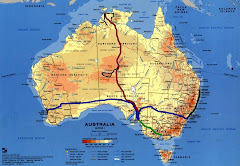
I stayed one night in Adelaide and caught the Gahn, another train which connects Adelaide and Darwin via Alice Springs. The journey takes three days and two nights one way to cover a distance of 2979km with a speed of 85 km/hour. But I only stayed on until Alice Springs. The train goes twice weekly in both directions, is approx. 1km long (including 2 Locomotives and Motorail) and can accommodate up to 500 customer.
The town of Alice Springs straddles the usually dry Todd River on the northern side of the MacDonnell Ranges. The region where Alice Springs is located is known as Central Australia, or the Red Centre, and is an arid environment consisting of several different deserts.
In Alice Springs, temperatures can vary by up to 28°C and rainfall can vary quite dramatically from year to year. In summer, the average maximum temperature is in the high 30s, where as in winter the average minimum temperature can be 7.5C.


The symbol of the Gahn is a camel and its handler in recognition of the pioneering Afghan cameleers.


Aren't they the most wierd-looking plants?


The car parks in Alice Springs are under umbrellas to protect the vehicles from the sun.


BERLIN

Tuesday, 2 September 2008

ADELAIDE - BOTANIC GARDENS

Yay - I am in Adelaide. Have a REAL bed and a shower. Man you learn to appreciate those things real quick if they are denied.
Look like those Asian Balls with something in it which makes music. You roll them around in one hand to calm yourself down.
The Adelaide Botanic Garden is a 125-acre (51 ha) public garden at the north-east corner of the Adelaide, in the Adelaide Park Lands. It encompasses a fenced garden and Botanic Park near the Adelaide Zoo. Adelaide Botanic Garden is one of three gardens that comprise the Botanic Gardens of Adelaide.

First set aside in Colonel William Light's city plan for Adelaide in 1838, it wasn't until 1854, after a public appeal to Governor Sir Henry Young that gardens were established at the current location. They were founded the following year and officially opened in 1857. The garden's design was influenced by the Royal Gardens at Kew, England and Versailles, France.
One of the garden's nineteenth-century directors was the botanist Dr Richard Moritz Schomburgk, brother to the German naturalist Robert Hermann Schomburgk. He was a major advocate for the establishment of forest reserves in the increasingly denuded South Australian countryside.[1]
Amongst other scientific and educational displays of native and international horticulture, the gardens hold one of the world's only propagated Wollemi Pine trees.


Empty - but oh so romantic. Imagine a couple in love in an moonlit night in it.

The Palm, or tropical, house is a Victorian glasshouse located to the west of the main lake. It was imported from Bremen, Germany in 1875 , opened in 1877 and restored in 1995. As of 2007 it held a collection of Malagasy arid flora.


Isn't it beautiful?


Wow - these are a kind of rare Asian water Lily's. Really special. They like it humid.


Wow - architecture which dares to dream.
As part of Adelaide's celebration of the Australian Bicentenary the conservatory was constructed in 1987 and opened in late 1989. The building was designed by local architect Guy Maron and has won awards for its design, engineering and landscaping. It is 100 metres (328 ft) long, 47 metres (154 ft) wide and 27 metres (89 ft) high making it the largest single span conservatory in the southern hemisphere. The conservatory houses at risk or endangered tropical rainforest plants from northern Australia, Papua New Guinea, Indonesia and south Pacific Islands. The conservatory is sometimes affectionately called "The Pasty" by locals, because of its resemblance to a massive semicircular stuffed pastry.

SHORT VISIT IN COOK

This is how it looks like inside my wagon...
Yes those ancient boxes on the ceiling ARE Televison stations.

Yo... this sign declares the priorities in Cook!

Isn't it a beauty?! Wow, can still not believe, that I travelling by train through Oz.

Cook is a railway station and crossing loop on the standard gauge Trans-Australian Railway from Adelaide to Perth, with no inhabited places around. It has a few houses, and fuel tanks for the locomotives. The crossing loop can cross trains up to 1800m long.


Do I have enough chocolate to survive this?


The town was created in 1917 when the railway was built. It is named after former Prime Minister Joseph Cook. It was effectively closed in 1997 when the railways were privatised and the new owners didn't need a support town there, although the diesel refueling facilities remain, and there is overnight accommodation for train drivers. The bush hospital is closed, and the shop is only opened while the Indian Pacific is in town. Cook is the only scheduled stop on the Nullarbor Plain for the Indian Pacific passenger train across Australia and has little other than curiosity value for the passengers. Today, it is said to have a resident population of four, and is essentially a ghost town.


Endstation Sehnsucht.


A couple of 4WDrives crossing the desert gen Perth. Looks like adventure and imagining to sit in those for hour and hours and hours I do cherish my spacious train.

The jail. Might be still in use - I did not checked. thought it was the loo - honest!


Cook is on the longest stretch of straight railway in the world, at 479 km which stretches from Ooldea to beyond Loongana. So out here a lot of things a irreplaceable. (Sign is in the Souvenir Shop!)

Casey and Scott my "stewards" full of fun and really really kind. They made the trip special!


When the town was active, water was pumped from an underground Artisan aquifer but now, all water is carried in by train. Attempts have been made to introduce trees and other vegetation, but these have not been successful.


And there it goes - another day. And even if it does not feels the way - it is irreplaceable.

HOW EMPTY IS "NOTHING"?

We are still travelling through the Nullarbor Plain. View Moments taken, when there was something to see apart from the rough beauty of the plain itself...
A little shed to store rubbish bags.

No you are not on mars and there are no little green guys around. Human communication.

Who would dare and try to conquer the Plains with this view day after day?!


The possibility for a traffic jam is rather slim.


Yay - a tree!


I wonder if its dead under this unmoved surface.


??? I do not have a clue what that might be or has been used for...

CROSSING THE NULLARBOR PLAIN

And it was truly amazing to cross the Nullarbor Plain by train and see wild Kangaroos hoping along in the morning – in the middle of nowhere…
The Nullarbor Plain is part of the area of flat, almost treeless, arid or semi-arid country immediately north of the Great Australian Bight. The word Nullarbor is derived from the Latin nullus for 'nothing' or 'no one' and arbor for 'tree'. It is the world's largest single piece of limestone, and occupies an area of about 200,000 km². At its widest point, it stretches about 1,200 km from east to west between South Australia (SA) and Western Australia (WA).

Historically, the Nullarbor was inhabited by the semi-nomadic Spinifex Wangai Aboriginal people. The average rainfall on the Nullarbor Plain is about 200 mm per year.
European settlers were determined to cross the plain, despite the hardships created by the nature of the Nullarbor. Although
Edward John Eyre described the Plain as "a hideous anomaly, a blot on the face of Nature, the sort of place one gets into in bad dreams", he became the first European to successfully make the crossing in 1841.


The plain is a series of tiers. Each tier is flat and was formed when the sea level was much higher than it is today.
The southern ocean, in areas, blows through many subterranean caves resulting in blow holes up to several hundred metres from the coast. One such area open for public inspection are the
Murrawijinie Caves, in South Australia.
Vegetation in the area is primarily low saltbush and bluebush scrub. A large part of the Nullarbor Plain is now a National Park.
The Nullarbor is known for extensive
meteorite deposits, which are extremely well-preserved in the arid climate. In particular, many meteorites have been discovered around Mundrabilla, some up to several tonnes in weight.


The Trans-Australian Railway railway line crosses the Nullarbor Plain from Kalgoorlie to Port Augusta. Construction of the line began in 1917, when two teams set out from Kalgoorlie in Western Australia and Port Augusta in South Australia, meeting in the centre of the Plain at Ooldea, an uninhabited area noted for a water supply. This original line suffered severe problems with track flexing and settling in the desert sands, and journeys across the Plain were slow and arduous. The line was entirely rebuilt in 1969, as part of a project to standardise the previously disparate rail gauges in the various states, and the first crossing of the Nullarbor on the new line reached Perth on 27 February 1970.


In utter vastness whatever is there seems to be even more special.

The epic journey begins...

After being in Perth for 5 months I finally left at the end of August to start my travels around Australia. I left on board of the Indian Pacific which connects Sydney and Perth via Adelaide. The journey itself takes three days and three nights one way or 65 hours to cover a distance of 4352km with a speed of 85 km/hour. But I only stayed on until Adelaide. The train goes twice weekly in both directions, is approx. 1km long (including 2 Locomotives and Motorail) and can accommodate up to 500 customer.
Wow - I am on the train, nothing awful has happened so far and I am still alive! The seats in front of me are free so I hoped over and have a big window and two seats for myself! :)
A bit further out of Perth the countryside begins to change - from lush green to marsh?


It is a one way line of train tracks only from time to time there are places, where parallel tracks are build so that two trains can get past each other. The freight trains have the right of way so the Indian Pacific is waiting quite often on those sidetracks to let the long long long freight trains pass.


Above Kalgoorlie by night. We stooped there and who wanted to was able to attend a "Whistle-stop-tour". We saw the "Super Pit" a mining site by night. I did not saw much at all but have been impressed anyway.

Say "Good Bye" with Geranien

31/08/08 - The last minutes prior to my departure. While the boyfriend of my landlady was taking last pictures of her apartment which will be rented out while the two of them are moving in together I was outside taking these pic's for my pop and mom, who both love to play with plants. But in good ol' Germany these plant do not get half this size, of course. ;)

Man that boyfriend is being so sweet! Offered me to drive me to the train station, helped me with my luggage, me being nervous and gave me a big "Good bye"- hug! And waves all the way back to his car. We are not being close pals at all, but he can emphasize so wonderfully!
Hope things will work out fine for him!